
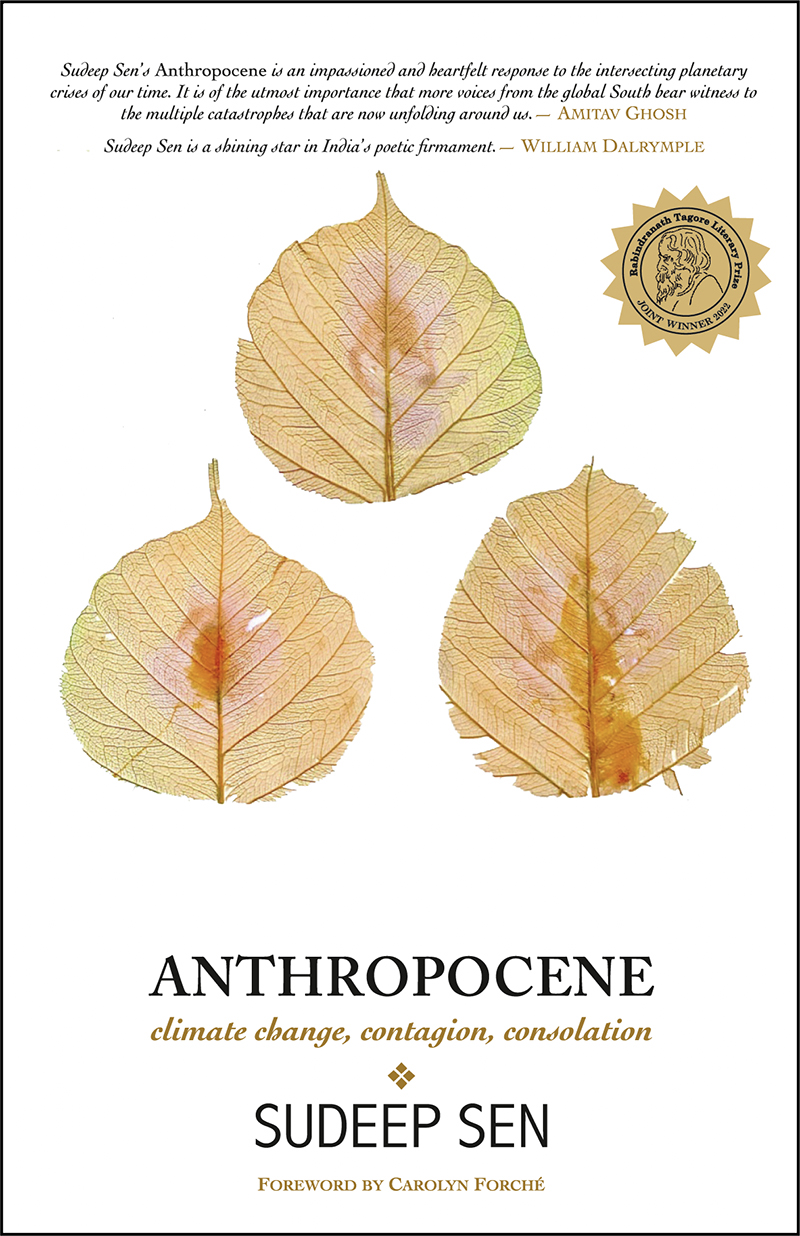
 Anthropocene focuses on today’s most urgent and important topics: Climate Change and pandemics – and the possibility of consolation.
Interviews and Other Mentions
Heartiest congratulations to Sudeep Sen on being elected Professor of Practice at
Panjab University, Chandigarh, India, in the Department of English & Cultural Studies.
__
Sudeep Sen is announced as a speaker at the Jaipur Literature Festival 2025:
Sudeep Sen – Jaipur Literature Festival
__
On the Commonwealth Poetry Podcast, which goes to 77 countries, Sudeep Sen is the subject of the whole of an episode.

The podcast hosts are Gyles Brandreth, the famous author, broadcaster and former MP, and his daughter Aphra Brandreth, MP
https://commonwealthpoetrypodcast.co.uk/episodes/episode-38-india/
__
Sudeep Sen on his Eco-trilogy of poetry books, Anthropocene (already published, and now available in paperback), Red (forthcoming), and Rock (forthcoming):
Rocks of Deccan Plateau Make Way Into Sudeep Sen’s Poetry | FridayWall
__
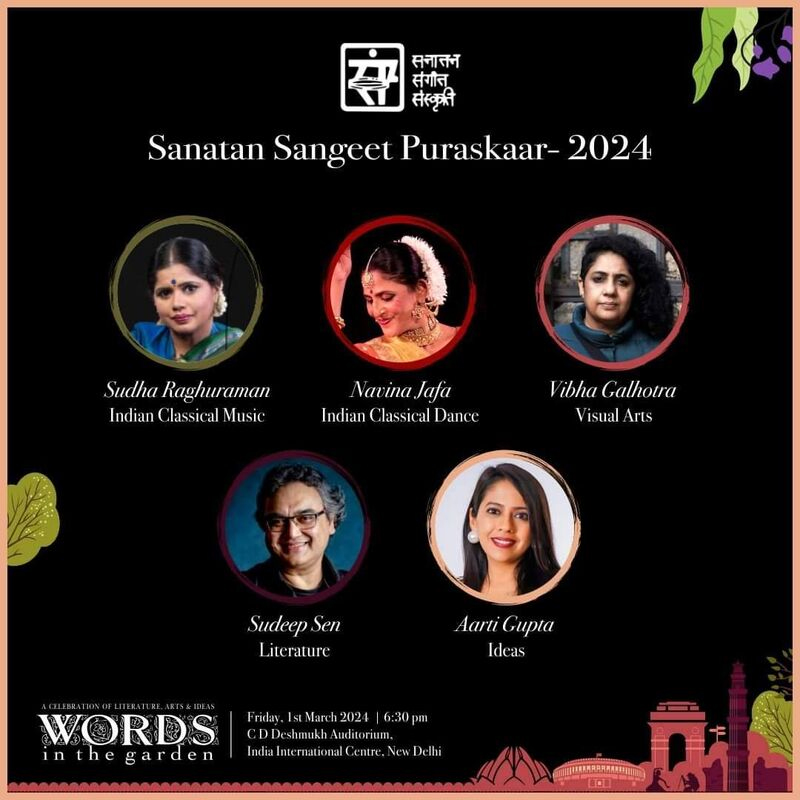
For a Lifetime of Achievement in Literature, Sudeep Sen wins the Sanatan Puraskar Award 2024 from the Sanatan Sangeet Sanskriti (established in 1990):
“Deftly tackling urgent issues of climate change and the pandemic by subtly juxtaposing the sciences and the arts, Sudeep Sen’s Anthropocene is one of the most important books of 2021″ – Jhilam Chattaraj in The Hindustan Times (New Delhi, India) on October the 22nd, 2021.
Please note that the London launch of this book was held at the Nehru Centre, 8 South Audley Street, London S1K 1HF on February the 10th, 2022. A recording of the event is accessible at https://www.youtube.com/watch?v=wiH4lTs2Me0&t=1268s
Articles, Book Reviews, Interviews, Literary Criticism, and Related Material:
Solitudes and Solidarities: Omar Sabbagh on Sudeep Sen’s ‘Anthropocene’
Sudeep Sen’s latest work, Anthropocene, is subtitled, Climate Change, Contagion, Consolation; and while it is a work replete with a poetic manner and reach which readers of Sen past will recognize as new and vintage ‘Sen’, it is also a work that evidently, purposively, has been configured to address a dovetailing set of communal concerns besetting, if not besieging, the world in its current dire state. And though the title and its subtitles do indeed outline or signpost a sort of poetic agenda or vision which streams through the book, the committed nature of the work is not pat politics or politicization. Primarily, because the deeply personal mixes with the mythic at times, and with, as well, the contemporary world’s most pressing and indeed universal dilemmas. Featuring formal and free verse forms, and a variety of prose modes (intimate diary, micro-fiction, prose poems, reportage), there is a doubling act in this book which is salutary: the artist’s native solitude is mapped onto the rigorous calling to (as the Prologue’s title has it), ‘not look away.’
Elsewhere Sen cites Brecht (one of a few Brecht-citations) questioning if there will still be song in ‘dark times’: answering, yes, there will be, about, precisely, the dark times. Indeed, the two epigraphs to the eponymous, second partition of the book, ‘Anthropocene: Climate Change’, are from Yeats’s ‘Easter, 1916’ and Derek Walcott’s Tiepolo’s Hound: and the paradox of Yeats’s ‘terrible beauty’ is ranged with ‘an altering reality for vision’ in which Walcott speaks of his ‘little strokes’, ‘syllables’, as being ‘not just his own.’ This double citation holds doubleness in each of its sides. New, pressing realities are terrible, but then beautiful, and are spoken-to in an artist’s own words whose ownership are, by that last token, immanently as much as imminently shared. For as in the later entry, ‘May Day’, in today’s world, ‘May Day’ is ‘every day.’ Or then, in one of the book’s most signal entries, ‘Love in the Time of Corona’ (a poem that has been translated already into several languages, and shared thereby), the reference to Gabriel Garcia Marquez is made doubly telling. In the pertaining epigraph Marquez is seen to say that he doesn’t believe in God, but is scared of him. This paradox, thus, a bit like the contagion of the Covid-19 pandemic: something incredible by way of its insidious and sheer invisible nature, but for all that, something to fear, deeply. Telling duality abounds.
So, when towards the end of the book, in a prose entry titled, ‘Poetics of Solitude, Songs of Silence’, Sen writes that he has ‘never needed external causes to internalize and live life solitary and indoor’ (a note paralleled earlier in the book’s Prologue as well), we alight on a sentiment that seems in context to hold another sense of paradox. In a time when the world is forced to a certain extent into mutual isolation, the introverted artist who requires solitude and silence in any case, suddenly becomes the icon of the universal condition. So that, in ways I hope to illuminate, solitude and solidarity map and/or dovetail across the meaningful purports of this book. The committed nature of the thematic contents can be seen to be engagements of an artist whose sensitivity is dual: there is the sense of sensitivity as emotionality, lived-out in many visceral and violent ways in the book’s responsive images at times, and there is the sense of the sensitivity of one who permits himself retreat. Between suffering and consolation, between the visceral violence of ‘pollution and co-morbidities’ and the delicate lyricism of personal observation and sentiment, the work can be called, in short, a work of sensuality. The skyscapes of solitude are limned at the same time as the different kinds of earthed solidarity that are engendered, necessarily, by extreme circumstances.
Indeed, this dual vision is embodied in some of the opening paraphernalia of the book as well. After the dedication, the book’s overall epigraph is verse in the original Bengali of Sen himself, and then the same in English translation. The wish for rain as ‘the only truth’ in this verse is both local, we assume, to the ‘steaming skies’ of the Asian subcontinent and holds, too, philosophical redolence as an image of the universal yearning for the gifts of flourishing. The local and the global marry in this formal opening to the book. And as with Sen’s previous major work, Fractals, the term ‘anthropocene’ is parsed at the opening as well, from the dictionary, a technical word that works as both noun and adjective. Its meaning (the world in the era of human dominion) aside, I do think that the act of defining a somewhat technical term (in a book that like much of Sen’s work uses images from the hard(er) sciences) is another instance of bifocality. The word is strange enough to need definition, perhaps, but also in being defined by the dictionary in all its detail, is shown to have groomed heritage. The old and the new, marrying thus, too. And the very opening of the book (after the prose ‘Prologue’) dedicated ‘for Aria’, Sen’s son, follows suit in being titled, ‘I.E. [That is]’. A very delicate lyric accumulates in this poem, aping a form of premise followed by inference. In three staggered stanzas, the apostrophized hears ‘the sea’ in ‘a lone rustling leaf’, then because his father considers ‘the sea silent’, the beloved hears the sea’s silence in his father’s ‘studio.’ And because of that, ‘the silence will not empty / the sea / of its leaves.’ This loving parody of an almost axiomatic kind of reasoning, about particular observations, intimates the world in toto in the way that wholly discrete and disparate elements are made to magically cohere (foreshadowing the ‘pages’ of watery flow to follow). And such oneness is deeply apposite to the way a father loves his son, or, if you like, thinks the world of him.
And in a final note on some of the formal tics of the work which are indicative of Sen’s sensibility, the vast majority of the book uses epigraphs at different levels (book-wide, for partitions of the book, and above individual poetic entries) and dedications in a layered and composite, near-configurative way. Many a time a citation or citations (from the likes of, say, T.S. Eliot, Derek Walcott or Fiona Sampson, among others) will even be woven into individual poetic entries – quotes not just signposting, thereby, a theme or outlining a stance on things above the beginning of the individual work. This not only shows poetic solidarity with famed poets and thinkers, past and present, the implicit invoking of an imagined or ideal community of poetic responses to dark times, but is also, in the very act of this, showing just how much a poet’s readerly solitude can be an avenue onto the world. While not wanting to ‘look away’ as a responsive literary artist, Sen can often build his sense of commitment and solidarity from the ‘study’ he details as his bower in the ‘Prologue’. In this sense, solitude and solidarity can become each other in the artist’s hands, eyes, and human dominion, a dwelling, domicile.
Perhaps it’s no accident, thus, that in the eighth, penultimate partition of the book (before the ‘Epilogue’), ‘Lockdown’, the acts of ‘reading’ and ‘writing’ prove central to the titles and entries there. At the close of a late entry of three linked haiku, ‘Handwriting’ (dedicated ‘for Michael Ondaatje’) ‘letterforms and words / bloom, come alive – spell.’ This has something of the textual punning magic of the famous ending of Elizabeth’s Bishop’s ‘One Art.’ Writing well can cast good, assisting spells. Indeed, just a little further back, a single haiku, ‘Ash Smoke’ tells a similarly strangely hopeful tale:
something still remains –
otherwise from ashes, smoke
would not rise again
– ‘Ash Smoke’ [p. 152.]
But before we get to the ‘Consolation’, the main bulk of the book preceding is about (and about) the difficult journey towards the earning of such redress.
2.
‘Speaking in Silence’, a poem dedicated for ‘Fiona’ (Sampson), not only interweaves strategically-placed citations of the latter’s recent collection, Come Down, but for all its solidarity, whereby the poet is ‘certain we will continue walking, together and alone, / now and in the life-after’, still, it questions in a metaphysical manner that indicates the ultimate solitude of the poetic voice. ‘…. Shall we return to aleph’s source, / to oxhead’s hieroglyph, to fountainhead’s genesis’; ‘… Are we on a robotic treadmill, / on a journey mapped out for us?’ The ‘us’ here tallies with both the ‘together’ and the ‘alone’ of above; with both the immediate, shared reality, and the broader existential predicament. This ‘dialogue-poem’ alludes to and works as a musical duet, a jugalbandi — music (in addition to poetry) being an important interest of both the poets at hand here.
Close-by, in a series of haikus, ‘Corona Haiku’, small and overt metaphysical entries are equally potent and vocal. Whether it’s the ‘havoc’ of the ‘virus’s vatic’ (‘Covid 19’), or the questioning in ‘Pandemic 1’, ‘will we find a more / compassionate world, after / this pandemic’s death?’, or in ‘Death’, the ‘dread of death, death of / loneliness – our choices / out of our hands’ – the answers are never definitive. Such is the solitude of a shared condition, a shared condition that, existentially, may have always been the case, but that in the contemporary climate is dearly intensified. In the third part of the long prose entries of ‘Black Box: Etymology of a Crisis’, titled, ‘There After: Memory, Will’, the philosophical register abounds, achingly:
… All night I dream in fragmented images. Memory plays tricks with my mind. Her story, his story, my story, history – all collude and collate.
The trailer I saw before was only a glimpse. The film is still being cut. We might yet change the narrative. But do we have control over destiny or karma’s fate?
– ‘Black Box: Etymology of a Crisis’ [p. 68-75.]
These are questions we all ask in loneliness, but questions, again, that seem to redouble in interest and depth in today’s crises-ridden world. After all, the contingencies of money and power, which might have proved screens before our crises-ridden era, aren’t quite protection anymore from the development of ‘global warming’ or ‘contagion’ and other ‘co-morbidities.’
Just so, in an early entry, ‘Disembodied’, we now live in a world where the body is ‘carved from abandoned bricks of a ruined temple’, a reality where the body is ‘worshipped, not for its blessing, / but its contour.’ And we end this disembodying experience ‘directionless – looking for an elusive compass.’ As the closing strophes of the ‘Prologue’ have it poetic form like bodily form is witnessing ‘our world’s passage from utopia to dystopia.’ And this kind of alienation is also perhaps, if not as overtly effected as in Brecht, an alienation effect aimed to wake the reader (via the disorientation) to our present losses. Much later in the book, in the now-reprised title, ‘Disembodied 3: Within’, we end with ‘Life’s dance continues – with or without us – / only in the understanding of what is, / is there freedom from what is.’ By this time, we are nearing the ‘Consolation’ part of the book, so the transience of the bodily life, souped-up in today’s world, is beginning to be redressed. And this last italicised quote (from the philosopher, J. Krishnamurti) does indeed epitomize the effect of the whole book: there is only hope for returning to a more poetic world, we might say, by not looking away, by squarely facing the loss of bodily life, in order, thereby, to learn in wisdom and transcend. Life’s dance continues, after all, even if, to quote Auden, ‘the Old Masters were never wrong,’ ‘About suffering.’
All this said, the solitudes of the poet’s recognitions are also at times soliloquies in or of solidarity. In one of a few entries in the book which either by titular conceit and epigraph or by attitudinal tone (one of prosy reportage) indicate the book’s committed ethos, ‘Obituary’, we read of the ‘Death knells’ as they ‘peal’. And though with, ‘Another sick, another dying, / another dead –’, yet, ‘yes, they were us.’ It’s not just the thematic of solidarity, humanistic in the sense that the wretched of the earth are connected to each one of us blessed with the current privilege of health, but that that last italicized entry is a quote from ‘The New York Times’ epigraph. In the very set-up of the poem then, some fanciful notion of the role of poetry as escape (looking-away) is abjured in favor of its role as a ‘daily’ wake-up call. The diary-like entries of the nearby ‘Newsreel’ open, after citing Brecht’s ‘When Evil-Doing Comes Likes Falling Rain’, at ‘9 am: Morning News’ with:
At nearly 50ºC, you do not need a pandemic to remind you of human agony and grief – you inhabit me.
Daily death toll rises, coronavirus continues to inflate, inflect. Enforced lockdown, xxxinhuman laws – weary migrants, hungry die on the highways.
– ‘Newsreel’ [p. 66-67.]
Those being, literally, disembodied, those bodies, as the early ‘Disembodied’ has it, we’ve seen, ‘carved from abandoned bricks of a ruined temple’, are also, we continue the verse here, ‘from minaret-shards of an old mosque, / from slate-remnants of a medieval church apse, / from soil tilled by my ancestors.’ In the midst of ruination, death and suffering, there is, it seems, the shared earth of consanguinity, humanity. It’s not for nothing that in the final, ninth partition of the book, the ‘Epilogue’, the three entries are: ‘Meditation’, ‘Prayer’ and ‘Chant.’ In the first of these ending-poems we end on: ‘Eyelids veiling / our pupils, see – a sense / of calm, peace, love.’ The pupils here are not just the poet’s two, but of all us, students of suffering. Recalling the earlier mention of ‘white space’, the ending of ‘Prayer’ speaks about how: ‘Five colours mix – / white.’ Equally, though, in ‘Chant’ following, closing the book, ‘black contains / everything’ and ‘all is one – // one is many – // many is all.’ So, while (still with ‘Chant’) it’s sad in today’s world that ‘everything contains / nothing –’ and that ‘nothing contains / all’ – such inverting truths about a denuded earth, a topsy-turvy world, as woken-up to, can only be or may prove to be signs of waking health. One hopes.
Indeed, to compound the black and the white of all of it, we read in ‘Summer Heat’ prose entries like: ‘No moisture, just steam, heat, heat, and more heat. Barren. Everything seems in short supply, except heat’. A bit later though, in ‘Shower, Wake’ we learn how: ‘With or without water, in flood or drought the existence here remains unchanged.’ This kind of yin-and-yang typifies many of the oppositional motifs that form and configure the staggered graces of Anthropocene. And if the opening epigraph of the whole book (mentioned above) from Sen in original Bengali and then Sen in his own English translation, yearned for the gift of rain, and of human flourishing, perhaps after all it is because of its ultimate simplicity, its black and white. Simply put, we are all so alone – absolutely together, ultimately, only in that equal solitude before nothingness. In ‘Rain Charm’ we’re given a ricocheting image, simply put, of the idiosyncrasies of our communal concerns:
Rain has a special seductive appeal – its innocuous wet, its piercing strength, its gentle drizzle-caresses, its ability to douse and arouse. The entire charm lies in its simplicity.
– ‘Rain Charm’ [p. 46.]
3.
In his ‘Prologue’ Sen claims this work as a ‘quiet artistic offering’. However, it is filled with alarums and bells performed by many visceral and violent images, emergent from the bodily realities of a blighted world. That said, combining the two, ‘Ganga Rising’ I think phrases the conundrum of the solitary poet excellently, as he needs must turn responsive, responsible, rising to the challenge – not to look away:
Here, there is no space for perfectly rounded pebbles or gentle musings – only large granite outcrops can shackle the soul’s ferocity – a jagged fierceness – not harsh, yet quietly robust.
– ‘Ganga Rising’ [p. 138.]
The imagery from the ‘Ganga’, so indicative of Sen’s native climates, is still in concretion and as metaphor universal in its river-ing reach. We can recognize poetry in the world only by recognizing and rising to that same world’s (now) deep-set imperfections. Even if Sen claims to be ‘quiet’ here in this timely book – it might be more apposite to say that he is also in many evident ways ‘quietly robust’.
__
The review above is included in this webpage with the author’s permission; originally published at The High Window website
There is now a growing body of literary criticism on Anthropocene. The latest such article is in the journal called dialog, No. 41 (Spring, 2023), pages 163-178: https://dialog.puchd.ac.in/wp-content/uploads/2023/09/10.-Anthropocene-essay-Tom-Phillips.edited.pdf
- 8 December 2022: Thorough and detailed book review by Somudranil Sarkar in World Literature Today (USA)
- ‘I’m constantly responding to what’s happening around us — how can one not?’: Poet Sudeep Sen | Books and Literature News, The Indian Express
- Canonical zeitgeist of the current global crisis: Sudeep Sen’s ‘Anthropocene’ – Times of India (indiatimes.com)
- Poetry is private and public, immediate and transcendental: Sudeep Sen | IANS Life
- In Reverse, The Verse Is Free And It Flows Freely | Outlook India Magazine
- Life in Verse | Financial Express
- Book Review | Kitaab.org (Singapore)
- A response to the contagion and climate change | Book Review |BusinessLine
- An Urgent, Timely Ode to the Planet | by Barnali Ray Shukla |Shillong Times
- Review by Suhasini Vincent | The Beacon
- Book Review by Hindustan Times
- Solitudes and Solidarities: Omar Sabbagh on Sudeep Sen’s ‘Anthropocene’ | The High Window (U.K.)
- Sudeep Sen / “The role of the artist is not to look away” – KLIMAAKSJON / NORWEGIAN WRITERS´ CLIMATE CAMPAIGN // NWCC (forfatternesklimaaksjon.no)
- Book Review by Fakrul Alam|Daily Star (Bangladesh)
- Book Review by João Ribeiro Mendes |Revistas (Portugal)
- Book Review by Emilia Mirazchiyska |Inkroci Rivista di Letterature (Italy)
- Book Review by Jennifer Mackenzie|Mascara Literary Magazine ( Australia)
- Book Review by Rifat Munim and Sumaya Mashrufa |Dhaka Tribune (Bangladesh)
- Book Review by Ratna Raman | PRATIK
- Book Review by Ankush Banerjee | Tupelo Quarterly (USA)
IF you are based in India, you can buy this at an Indian price on Amazon.in
Amid all the negative noise in the world, Anthropocene is a quiet artistic offering — a testament to our fervent times where the ever-increasing ravages of climate change scar humanity, where Fascist politics overrides the silence of introspection, where the cleaving schism between the rich and poor becomes ever-widening, where racism peaks at an all time high, where toxicity among people proliferates, and fake news abounds.
Ultimately, Anthropocene is a plea for positivity and prayer — it urges us to slow down, to introspect, to consume less. It is time once again to learn how to love selflessly and embrace “Hope, heed, heal — our song, in present tense.”
Brief Quotes:
A mighty, ambitious work — and it couldn’t be more timely. There is a bounty of riches here, the mixed genres working harmoniously together as they enhance the overall argument. The voice carefully steps away from didacticism or rhetoric, finding beauty and grace in its journey across the pages.
– Lavinia Singer, poetry editor, Faber & Faber
‘One of international poetry’s guiding stars’ – Paul Cooper in New Welsh Review
‘A word-scientist, a master grammarian’ – Weekend Observer
[On EroText] ‘Lo, Anais Nin + Henry Miller! #India. Sudeep Sen’ – Margaret Atwood on Twitter
‘Poised, elegantly constructed poems which provide calm spaces for the reader to inhabit’ – Carol Ann Duffy, former U. K. Poet Laureate
‘Sudeep Sen is a shining star in India’s poetic firmament. —William Dalrymple
‘Sudeep Sen’s poems are a present which bring — like all true poetry — so much companionship’ – John Berger
‘[A] fine bilingual edition of the poems of the great Kaifi Azmi’ . Amitav Ghosh on Instagram
‘The best-known Indian poetic voice of his generation…. Sen has carved out a distinctive space for himself. It’s time for the rest of us to sit up and take notice.’ – Shashi Tharoor on Outlook
‘I was really happy to lose myself in the learned and intricate mosaic of prose-poems [in EroText]… . Your book really stayed with me — for its evocation of rain, for its love of Japan, for its commitment to the writing life and for its freshness. —Pico Iyer
‘Fractals gathers more than three decades of poetry from one of India’s most technically gifted poets working in English. Sen’s poetic scope and knowledge of form and metre will dazzle poetry lovers while drawing in more casual admirers with his sophistication of language and range of topics. Fractals is an important retrospective collection from a poet even now just reaching the height of his powers’ – World Literature Today (USA)
‘A fine contemporary voice whose work is simultaneously urgent, intelligent, innovative, crafted and lyrical’ – Peter Porter
‘In Fractals, Sudeep Sen has created an impressively unified account of his long-term engagement with poetry as fusion of both passion and precision. Sen’s international poetic reputation is founded on his distinct blend of personal, meditative lyricism with camera-sharp imagery and contemporary allusion. A vividly-focused, confident, comprehensive collection’ – Jane Draycott
‘Sudeep Sen has a sharp eye for the irregularities of the global landscape. What is most remarkable is an unusual directness of expression which gives immediacy to his many experiments with form’ – Elaine Feinstein
‘Sudeep Sen is a truly international poet. …. he is also simply a very fine, highly imagistic poet; one who produces such brilliant, tightly stitched pictures …. this rhythmically choreographed insight has also been constructed by and through images. His thinking-with-pictures makes There is a grammar to his images that allows him to build with them…. Sen is a highly discriminating poet’ – Fiona Sampson, The London Magazine
‘Sudeep Sen is a cosmopolitan poet par excellence, who knows how to interweave in his redefned and brilliant poetry, all the possible nuances of an imaginative global poetic language’ – Magda Carneci
‘Prayer Flag is a unique object of art that reveals two intrinsically linked artistic sides of Sen’s work and talent: words and images. Perfection of musicality, tone and cadence is tuned to produce the finest resonance . . . A gift to treasure from a master artist’ – Tom Alter, Biblio
‘A rich, fluent, cosmopolitan voice’ – Peter Bradshaw in London Evening Standard
‘A poet of technical facility’ – Bruce Kingin The Oxford English Literary History
‘Sen is an eclectic poet whose understated work eschews fashionable trends, while exhibiting considerable technical virtuosity and versatility’ —John Thieme in Cambridge Guide to Literature in English
‘Sen [has] extended the range of Indian verse in English to encompass a variety of alternative views of language, history and culture’ – Chris Cook, ed., Pears Cyclopaedia (Penguin)
‘A gifted poet …. I think everyone who works in Indian literature in English should thank him for all he has done’ – Dom Moraes in Midday
‘In this artfully put together anthology [Aria], Sen translates from many languages. Sen’s own translation of Jibanananda Das’s ‘Banalata Sen’ is luminous enough to carry the entire book’ – Arshiya Sattar in Outlook ‘Best Books of the Year’
‘I read Rain with considerable admiration and pleasure. It is a word-perfect collection and its subject matter is both the measure of the rain and the spoken line’ – Amit Chaudhuri in The Statesman ‘Best Book of the Year’
Poetry Film by Sudeep Sen:



Reviews
There are no reviews yet.