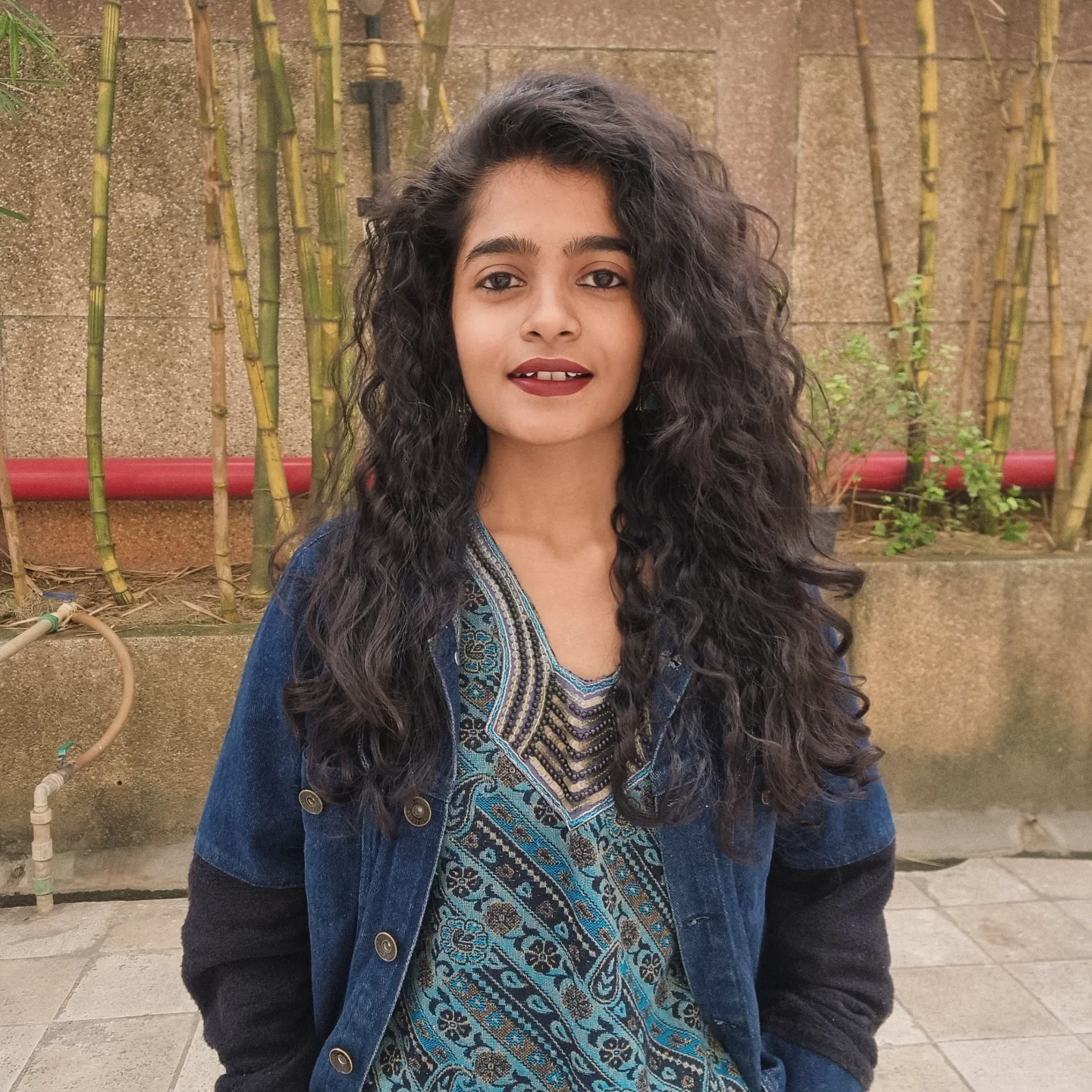
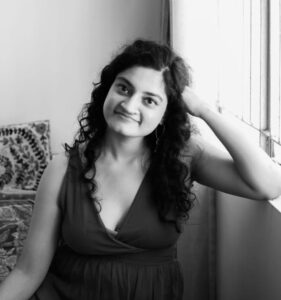
 Kuhu Joshi is the author of My Body Didn’t Come Before Me (Speaking Tiger, 2023). Her
work has been published in Poetry, Best New Poets, Four Way Review, Rattle, South
Carolina Review, and other publications. She earned an MFA from Sarah Lawrence College,
where she was a Jane Cooper Poetry Fellow and studied under the mentorship of Marie
Howe. She has received support and funding grants from the Academy of American Poets,
Napa Valley Writers Conference, Tin House, the Teaching Artist Project, and Vermont
Studio Center. Joshi teaches creative writing and composition at Pace University and the
City University of New York. Her personal website is kuhujoshi.com.
In this edition of In Conversation, Kuhu reflects on the relationship between embodiment and
selfhood, her experience of living with scoliosis, and how she reclaims power through
writing. The conversation also touches on her approach to writing as a practice grounded in
necessity and contradiction, and explores the tension between hope and despair, suggesting
that writing often exists in a space of contradiction rather than resolution. She also speaks
about her workshop, Writing Towards Hope, as a collective space for writers to engage with
both hope and despair, and offers advice to young writers.
Samiksha: Kuhu, I’m so glad we’re able to have this conversation! I want to begin by asking you the same question you ask and answer in your book, My Body Didn’t Come Before Me – “Who is a woman before she becomes just a body?”
Kuhu: Thanks, Samiksha! Always a pleasure speaking with you. You know, it’s funny, I actually still find myself grappling with that question. Honestly, the answers keep evolving as I age. I’m still writing about the body, vulnerability, and personal agency. But if I had to answer that question today — “Who is a woman before she becomes just a body?” — I would say she is whoever she wants to be.
Samiksha: In your book, you explore the distinction between ‘the body’ and ‘the self’. You mention a disconnect between the two that enables us to envision ourselves as ‘more than just a body,’ and rightfully so, but your work also touches on the fact that we do not get to choose our bodies. How can one move from a potential unhealthy disconnect between the body and the self towards a healthier relationship between the two, and what does that entail in terms of how we view ourselves?
Kuhu: I think I had to take the body and the self apart in order to come back and join them together. When I say ‘My Body Didn’t Come Before Me’, in a way, I am also saying that the two are inseparable. My body is me. In that sense, there is no before or after, just a continuous whole. As a child, when I was diagnosed with severe scoliosis, I was told that what was happening to me was not normal. My body was perceived by the medical world and by society as “deformed” and “abnormal”. And it made me feel like I was abnormal too. That because I had scoliosis, something was wrong with me. That I needed to be “fixed”. I could never just be, you know? So I suffered. And from that suffering came the need to tell the story of my body, to rewrite and reclaim it for myself.
Samiksha: The idea of rewriting and reclamation the story of one’s body is so powerful. In your poem, Big the line “I cannot bear my flesh/who taught me this?” really stayed with me. What role do people and society play in teaching us to be unable to bear our own flesh – or ourselves – and how do we begin to unlearn that?
Kuhu: Society is the main culprit here, and now I think also social media, in a major way. We consume unrealistic standards of wellness and beauty. It’s hard to view our bodies as normal just the way they are, instead of projects to be constantly managed and fixed. I think radical self-love is the answer. Choosing to accept yourself as you are every single day is a radical act in the face of a culture that says you’re too this or too that. (Read: too big, too small, too pimply, too dark, too hunched, the list doesn’t end..) I am working on tuning my inner voice to a kinder one.
Samiksha: In your book, I notice a progression of a picture of the self being made poem by poem – The transition from what society or even doctors might sometimes perceive as ‘just a body’, to a real, breathing, woman with agency and personhood. What does that journey look like?
Kuhu: I love how you phrased that: “the self being made poem by poem”. It made me think of a flip-book! My book ends with the speaker moving out of her family home and living by herself, excited by her first thunderstorm in her own apartment. She is thrilled at the possibility of crafting a home for herself, however messy it might be. I wanted to end the book with hope and empowerment. In real-life, however, the journey does not look so linear. I still live with severe scoliosis, chronic pain, fatigue, and several other challenges. And I know I always will. I have a yoga practice (and I also teach others) to manage pain and health issues that come with scoliosis, but I am no longer trying to get rid of it. It’s daily work, navigating the body and its limitations, making and unmaking a self. It’s a difficult journey, with a lot of unpredictability and pain. But it is not without pleasure.
Samiksha: It takes a lot of courage and even more vulnerability to write about things as they are. You do this beautifully and assertively in poems like, The day of the fitting, The girl with a rod, I tell myself I am beautiful and countless others. How do you find the strength to do this in a world that does not always treat our vulnerabilities with care?
Kuhu: Thank you! I struggle with being assertive, but the page is where I go to find my voice. Reading work by other writers who are being brave and vulnerable helps me too. And all my mentors. You gotta find your people. Sometimes these are fictional people, characters from books, or the authors whose books you love. They can teach you to take some risks for yourself on the page.
Samiksha: They say the best writing happens from a place of deep vulnerability. Would you agree?
Kuhu: Yes, and no. I think vulnerability is an essential ingredient, but the best, the truest writing arises out of deep necessity. You get the sense that the writer needed to tell this story, or write this poem, and in that sense it’s almost urgent, even obsessive.
Samiksha: Oh, I love that distinction between vulnerability and necessity!
Even when your writing emerges from deeply personal experiences, it never feels overwhelmed by emotion. Instead, there is a strong sense of self-possession and self-assertion running through it. How do you strike that balance?
Kuhu: By studying the craft. And studying other writers who are doing what I want to do in my writing. Tishani Doshi and Aditi Rao were some of my early inspirations. I had lots of lightning-bolt moments of ‘oh I want to write like this too’. I think the trick also is to write towards discovery. If you’re only putting what you already know on the page, even if it’s vulnerable, it’s not going to do much more than convey an emotion. What you want is to alchemize that emotion into something larger. You want to write towards what you don’t know. And then maybe, just maybe, you and your writing will come out changed by the process.
Samiksha: That’s beautiful. Kuhu. You also host a workshop called Writing Towards Hope. Could you tell us a little bit about the workshop? And I also want to understand what ‘writing towards hope’ entails as a personal practice.
Kuhu: My poetry-sister Kandala Singh and I hosted Writing Towards Hope because we felt the need to create a community where beginning and experienced writers could gather to generate some light in dark times. We read poems about hope and resistance, and wrote our own in response to generative prompts. There was something beautiful about doing this at a collective level. Personally, I write dark, depressing poems, haha. I don’t know… it’s hard for me to write hope and joy. You cannot force it. Sometimes it’s about letting your writing hold all the contrasts and dualities. My practice exists more in that dialecticality.
Samiksha: Earlier you mentioned the importance of writing from a place of necessity. In a world that often feels bleak or overwhelming, especially today, how necessary is it to write from a place of hope or towards hope? And what does hope actually achieve?
Kuhu: That’s a good question, because on the one hand, my hope is not going to do anything to change the world, but on the other hand there can be no action without hope. I think despair can be dangerous, especially today. We have to resist.
Samiksha: Kuhu, I attended your Writing Towards Hope workshop, which I found to be a very hopeful and uplifting experience. As a creative writing instructor, what advice would you give to writers starting out?
Kuhu: Thanks so much! Persistence and patience. It’s a long road ahead, try to have some fun while you’re writing!
Samiksha: Thank you so much Kuhu! It was really lovely talking to you and hearing your thoughts!
__