
“An important and timely book – a must-read in every newsroom” – Richard Porritt, Regional Editor, Newsquest, UK
“A brilliant and unexpected study of how journalism came to be the enfant terrible of the modern world, and what it would mean to lose it” – Tom Holland, historian, and multiple prize-winning author of Dominion, Dynasty, Millennium, and Persian Fire; UK
“Ably chronicles the rise and fall of public interest reporting, and what we have lost as the powerful can now operate with fewer restraints” – Marvin Olasky, in the Olasky Books newsletter from The Discovery Institute, USA
“’Saving Journalism’ is an important book and Dr Jenny Taylor is eminently equipped to write it. The fourth estate is a vital part of a healthy democracy but, alas, ill fares the land! Jenny excavates afresh the roots of journalism, gives poignant examples of her own and others’ experience, and lays the groundwork for a renewal of healthy journalism” – The Revd Professor Craig Bartholomew, Kirby Laing Institute, Cambridge, UK
“I’ve loved reading ‘Saving Journalism’. Rarely are Mary Magdalene, Martin Luther, Karl Barth and W.T. Stead cited as role models for contemporary journalists. But Jenny Taylor’s passionate and captivating analysis of journalism’s spiritual roots helps explain many journalists’ brave and determined pursuit of social justice and why reconnecting with its soul is important for journalism’s re-invention and survival” – David Lush, journalist, development worker, and publisher; UK and Namibia
“Over a distinguished career, Jenny Taylor has reported from some of the most dangerous places in the world, studied the origins of journalism, and analyzed its current woes, especially the pernicious effects of secularism. She brings these experiences together in a lively overview of what ails news and what can be done about it. All journalists should read it, as should many others. There is nothing else quite like it” – Dr. Paul Marshall is Wilson Distinguished Professor at Baylor University, and Senior Fellow at the Religious Freedom Institute as well as at the Hudson Institute, Washington DC, USA
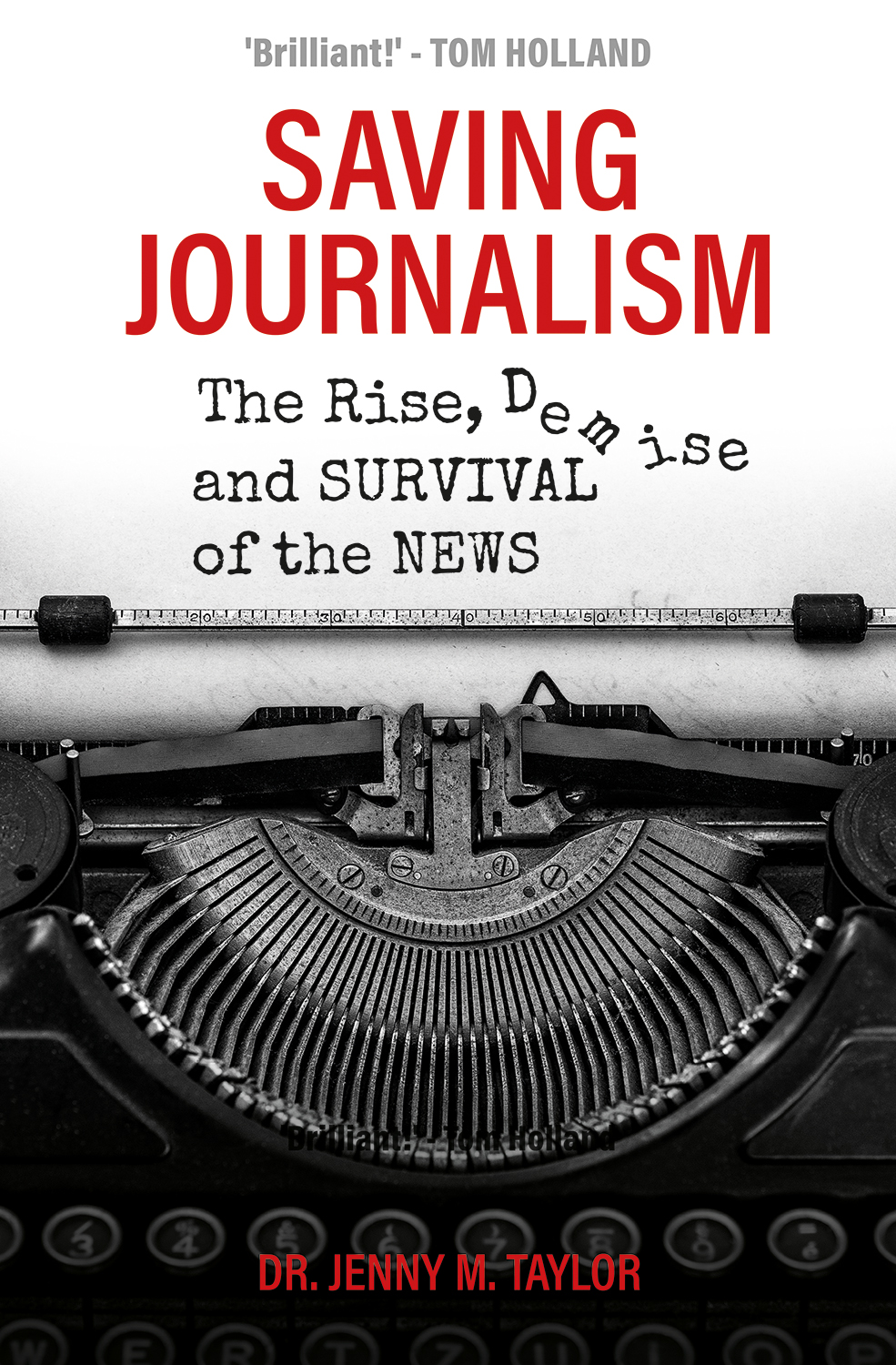
The Rise, Demise and Survival of the News
by DR JENNY M. TAYLOR
Could the flourishing history of journalism provide clues for enabling it to flourish in future? Why is society’s watchdog, the press, with its long and often honourable pedigree, going feral? Failing to bark at misrepresentation and fraud, while snarling at truth?
Why does journalism have the privileged position it does? As commercialization collides with the greatest communication revolution since Gutenberg, why are both revenues and media ethics in meltdown?
If digital and now AI-produced media have “the most prodigious capability for spreading lies the world has ever seen” (Alan Rusbridger, Editor, The Guardian, U.K.), is it coincidence that readers turning away in the millions, globally?
Yes, news mongering there has always been! But responsible journalism has foundations that have been sadly neglected.
Why did journalism – the Fourth Estate epitomized by Edmund Burke – emerge first in Europe, even though China had printing nearly a thousand years earlier? That epic tale is not known to many people today, not even most journalists.
How far back do the origins of public discourse go? What was it about moral fervour, all the way back to the Hebrew people, that revolutionized not only Greek and Roman classical narrative, but also the understanding of values, character, personality, and indeed language itself? Should it surprise us that America’s first newspaper editor was a Christian preacher? What was the connection between Bible translation and public discourse, of which responsible journalism was the most brilliant – and indispensable – adjunct?
For some, a surprising tale, for others even an unpalatable one: Saving Journalism recounts its often heroic past – and, just possibly, may equip and inspire readers to help win back its future.
JENNY M. TAYLOR began her career in 1974 as Arts Editor of Palatinate, Durham University’s student newspaper. She then became an indentured reporter with a weekly in the Yorkshire Post Group – the award winning Goole Times. Two years later, she moved to The Evening Advertiser in Swindon as a Senior Reporter and Arts Editor.
Over the years, she has contributed to The Guardian, The Times and, in translation, to the European press. Following her Ph.D. at the School of Oriental and African Studies, University of London, she has published in academic journals while also continuing to publish in the mainstream and online media.
Widely recognised as a cultural analyst and journalist, she was the founder of the charity, Lapido Media, described by historian Tom Holland as ‘groundbreaking’ because it helped to bring the national media up to date with changes in the demography and cultural climate of the UK. She is Research Fellow in Communication, Media and Journalism at the Kirby Laing Centre for Public Theology in Cambridge.
Her earlier books are “A Wild Constraint” (Continuum 2008), an extended essay on contemporary sexuality; and “Faith and Power: Christianity and Islam in ‘Secular’ Britain” with Lesslie Newbigin and Lamin Sanneh (SPCK 1998, and Wipf & Stock 2005).
Prabhu Guptara –
Please note that it is I who am assigning 5-star status to this review, on the basis of the actual review by Peter Crumpler, who (among other things!) says:
“Taylor’s book is a valuable contribution to ongoing conversations about the future of journalism. Increasing religious literacy among journalists and media outlets could strengthen the credibility of their reporting – especially in a world where religion continues to play a major role, often far more than many journalists appreciate.”
The full review is published at https://www.premierchristianity.com/reviews/have-we-forgotten-the-christian-roots-of-journalism/20028.article