
Delhi, November 1984
1 November 1984, a Thursday, is a day I can never forget. I was a professor then at Hofstra University in Long Island, where I taught a heavy load of courses on Monday, Wednesday and Friday, each week. However, my most enjoyable teaching during 1984–85 took place every Thursday at Wesleyan University—a once-a-week course on African American drama that included well-known plays on race and identity by Langston Hughes, Lorraine Hansberry and LeRoi Jones. I would leave my home in Bayside, Queens, around 9 am, arriving in Middletown, Connecticut, two hours later. I would teach my three-hour class from 1 pm to 4 pm, getting back home by dinner time.
On Wednesday, 31 October 1984, the news of Mrs Gandhi’s assassination had flashed across the globe. As we walked together on the Hofstra campus from one building to another, my Jewish American colleague Susan had expressed serious concerns about the retribution that would most likely be visited upon innocent Sikhs in response to the dastardly act committed by Mrs Gandhi’s bodyguards. In my naïve Nehruvian idealism, I had attempted to reassure my colleague that while some anger would probably be directed at Sikh citizens in the streets, the reaction would not be too extreme. Spurred possibly by the long memory of her Jewish heritage, Susan had predicted the situation much more accurately.
Driving from Queens, NY, to Middletown, CT, on Thursday morning and returning home in the afternoon, I was tuned in to the CBS News Radio. I was deeply shaken by what I heard. Driving in either direction, I was forced to face a new reality about my beloved homeland, as the number of Sikh killings reported from New Delhi kept doubling every half hour. In fact, on my return drive home to Queens, I felt compelled to turn off the radio and find solace in the Gurbani kirtan cassette tapes that were always in my small Datsun car during those years. Kabir’s reassuring message came through in the melodious voice of Ragi Harbans Singh: ‘Aval Allah noor upaya, kudrat ké sabh bande/ek noor té sabh jug upjaya, kon bhalé, kon mandé’ (First, Allah created the Light; then, by His Creative Power, He made all mortal beings./From that One Light, the entire universe welled up. So how can some be good, and others be treated as bad?).
As I navigated the always crowded I-95 toward Throgs Neck Bridge to reach home, I attempted to remain focused on the road, even as Guru Nanak Dev’s 1519 protest to God against Babar’s brutalities upon hapless citizens roared into my memory: ‘Eti maar pai kurlané, tein ki dard na aya’ (In the face of such slaughter, Oh God, did you feel no pain or empathy?). At that moment, it was difficult for me to be philosophical about a pattern of human history—how individuals, families, communities and nations perpetrate actions (domestic abuse and incest, repression of Indigenous Peoples in Canada and the US, slavery and colonialism, Jim Crow and Japanese internment camps in North America, Holocaust in Germany, apartheid in South Africa) that cause multi-generational trauma—actions that would call for subsequent regret and apology, truth and reconciliation commissions, or reparations. At some point in 1999, I was shocked to learn that when Patwant Singh, Kuldip Nayar and Lt General Jagjit Singh Aurora met with President Zail Singh and Home Minister P. V. Narsimha Rao, respectively, on 1 November 1984 to seek their intervention, the two leaders took no action at all, letting the killings of innocent Sikhs go on for another 48 or more hours (Kaur 2001).
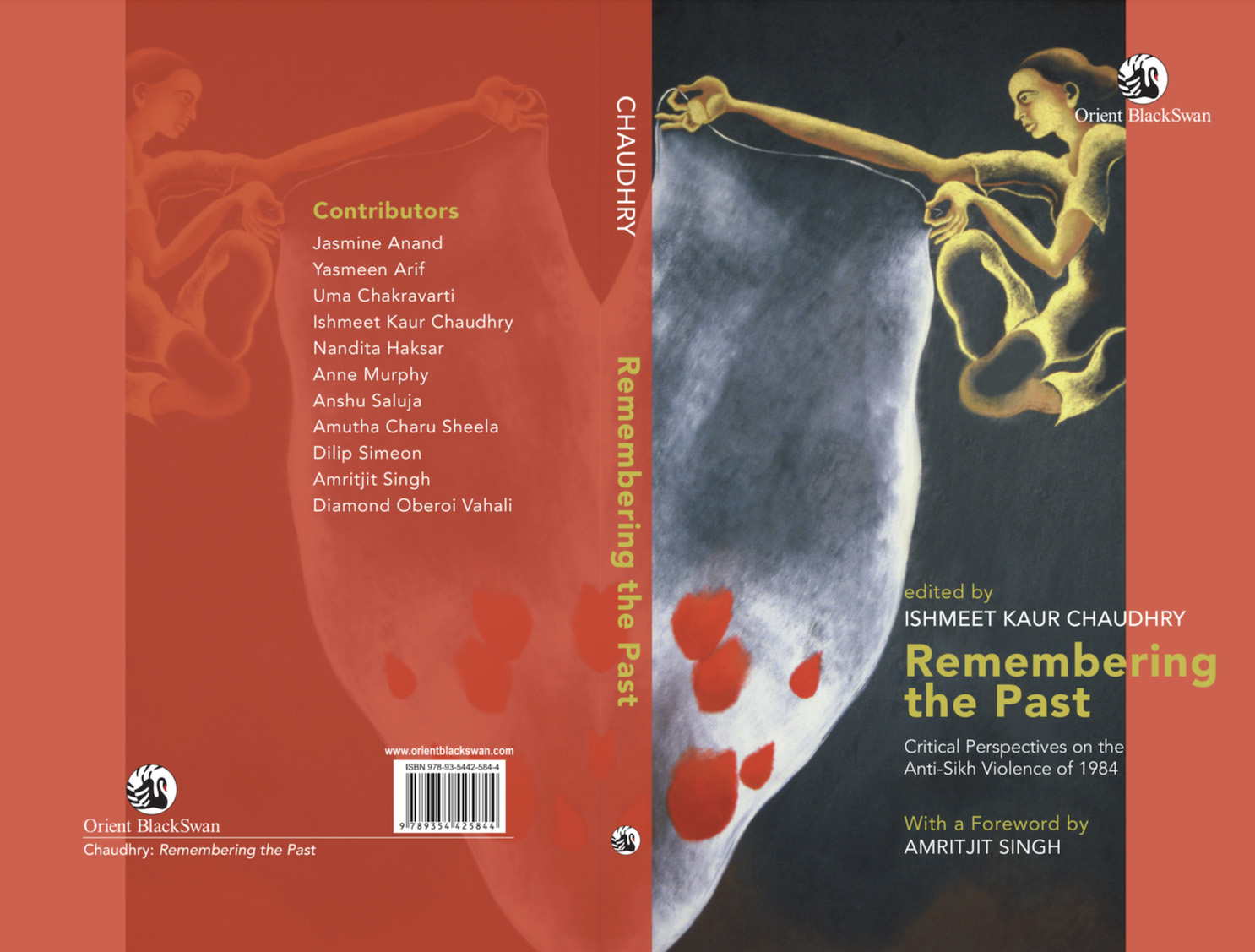
The excerpt above is from the Foreword to Remembering the Past: Critical Perspectives on 1984 Anti-Sikh Violence, a collection of essays edited by Ishmeet Kaur Chaudhry. The excerpt is included here by her permission as well as the permission of the author, Dr Amritjit Singh. The other contributors to the book are: Nandita Haksar, Uma Chakravathy, Dilip Simeon, Yasmeen Arif, Anne Murphy, Diamond Oberoi Vahali, Anshu Saluja, Jasmine Anand and Amutha Charu Sheela. Remembering the Past is the very first volume to offer a critical assessment of literary texts on the 1984 anti-Sikh massacres – works that cover a variety of experiences connected with both June 1984 in Amritsar and November 1984 in Delhi and other locations. These experiences stem from the violence faced by innocent Sikh pilgrims who had gathered at the Harmandir Sahib in the first week of June 1984 to commemorate Guru Arjun Dev’s martyrdom anniversary; the trauma resulting from the brutal killings of innocent Sikh families, especially their adult males, in Delhi and elsewhere; the humiliation and rape of women – but also, how Sikh women persisted in their fight for justice without much institutional support throughout the terrible 1990s in Punjab. The essays in this volume and the editor’s compelling ‘Introduction’ collectively signal how survivors of the 1980s and the 1990s attempted to recover from the trauma of what they had experienced and question whether full recovery is ever possible. Further, the book addresses crucial concerns related to the reading of communal violence through personal experiences. Novels, short stories, films and oral narratives that explore the painful subject of 1984 are also examined and evaluated from a literary point of view.
To order a copy of this book, please click here.
